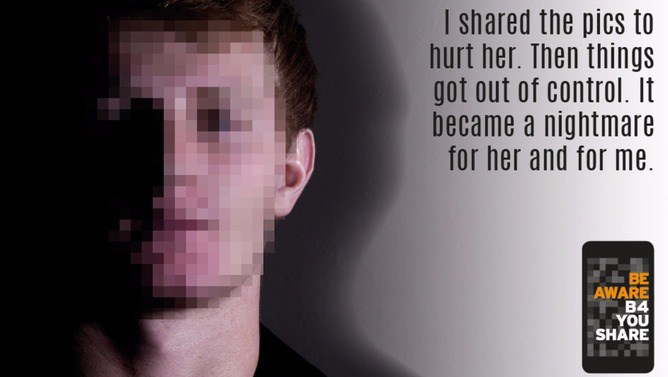
By starting off this topic of revenge pornography, we must firstly discuss what it actually means. Revenge pornography is the distribution of private sexual materials such as pictures or videos of another person without their permission.[1]This is often done by that person’s partner or someone they were having a sexual relationship with in order to cause embarrassment or hurt. This offence will apply both online and offline.
Due to technology constantly being improved over the years in terms of phones and what we can do with them, conversations nowadays involve in sending pictures to one other as a way of communication which has caused a great rise in the amount of sexual images online. This has created the issue of “sexting” which is sending an explicit image of yourself to the person you are currently texting which can be that person’s partner or just someone they are sexually attracted to. This had led to a number of problems in terms of socially as this method has become undoubtedly popular among children and the youth of today as it is seen as a normal thing to do.[2]The issue of children sharing such images isn’t a legal problem but more so a social problem as the UK already has legislation in place to deal with this which is the Protection of Children Act 1978 which applies for England and Wales and the Civic Government (Scotland) Act 1982 for Scotland which deals with indecent images of children. It is a difficult issue as sometimes the sender and receiver of these images will be underage therefore it is not entirely fitting to use the full force of the law.
The growth of sexting has also become popular among those over the age of 18 with partners often using this method to keep their relationship exciting and to supplement their relationship as a majority of young adults will now be in possession of sexual images taken by their partners. It is often the case that when relationships break down for whatever reason that often one of the partners will in anger take to the internet to share these pictures or videos against the will of their partner. When it comes to revenge porn there are a number of ways you can do this e.g. putting it on a certain website which weren’t actually in the UK and then it would be shared around. An example of one of these websites was IsAnyOneUp.com.[3]This website was being used as a revenge porn site during 2010 and 2012 in which it was held thousands and thousands of explicit pictures of women had been posted with links to their social media accounts. The more direct approach which would spend less time online but would be by far the most hurtful would be posting that content directly to a social media platform such as Facebook, Twitter, Snapchat and Instagram which have millions of users across the world. This could have an astounding effect on someone’s life which could result in bullying and even worse depression. An example of this would be 22-year-old Shaunna Lane who in 2014 had her private images shared on Facebook by her ex-boyfriend which left her “scared to leave her flat”.[4]Her interview can be found in the link below:
Clearly this shows how much of an impact it can have on its victims. Until 2015 there had been no direct legislation which deals with the issue of revenge pornography which meant there wasn’t a lot the victims could do about it which can be highlighted in the case of AMP v Persons Unknown 2011.[5]In this case the victim had her intimate pictures removed from her phone which had been either lost or stolen in 2008, but due to there being no legislation in place for this specific issue she had to resort to a mixture of copyright law. In today’s society this would not be the case as revenge pornography has become such a large issue that legislation had finally been put through in 2015 which came in the form of the Criminal Justice and Courts Act 2015[6]for England and Wales which now makes it an offence. Under this legislation it is an offence to ‘disclose a private sexual photograph or film if the disclose is made (a) without the consent of an individual who appears in the photograph or film, and (b) with the intention of causing that individual distress.’[7]According a BBC News article in 2016, more than 200 people have been prosecuted since the act came into force. Alison Sauneders who is the director of public prosecutions said “technology has created a new landscape for controlling, sexually-motivated or other forms of inter-personal offending and that we’re working very hard with prosecutors and with social media companies such as Twitter and Facebook to make sure that we understand exactly how social media might be used but we also understand how we might extract evidence from social media.”[8]The introduction of this legislation is definitely a step in the right direction to tackle the issue.
Following the decision to create the Criminal Justice and Courts Act 2015, Scotland had also decided to follow its footsteps to introduce legislation to help prevent the issue of revenge porn by introducing the Abusive Behaviour and Sexual Harm Act 2016 which now makes it easier to prosecute in Scotland. Michael Matheson who is the Justice secretary said, “It would give police and prosecutors robust powers to tackle the issue, social media is great for people keeping in contact but it is also being used in an abusive way by some individuals, particularly around the disclosure of intimate images or even threatening to do so”.[9]As mentioned earlier both these acts had come in response to a growing issue which has been going on for years as technology has made it easy to take pictures and videos without the other person knowing. The new offence will cover ‘photographs or films showing people engaged in a sexual activity which would not usually be done in public, or with their genitals, buttocks or breasts exposed or covered only with underwear’.[10]The whole point of introducing these legislations is to highlight the consequences of sharing these intimate pictures or videos which were taken in good faith that it would not be shared. Under this act if someone is convicted they could potentially be facing up to five years in prison.
Another case we can discuss is that of Chrissy Chambers who won damages against her ex-boyfriend in a landmark revenge porn case. Chrissy who is a YouTube celebrity managed to win damages against the man who uploaded videos of her online. The man who cannot be named had filmed several videos of them having sex without her knowledge and 2 years after breaking up decided he would upload them to a free porn sit which has since been shared on 35 other porn sides and has been seen thousands of time. This just goes to show that after a video has been uploaded how fast it can travel to other sites.[11]

We can now move onto speak about Lawrence Lessig’s modalities of regulations. Lawrence believed that the internet could be regulated by four constraints which would be the following
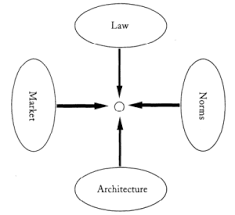
- The law
- The social norms
- The market
- The architecture
When speaking about the law, this is the legal framework and punishments therefore now that legislation has been put in place to deal with the issue of revenge porn. This will reduce the number of cases that will be reported due to people now being aware that it is illegal and can result in a jail sentence If convicted so they will think twice whereas before it was a lot easier to get away with. Social norms which is the social expectations, I think this needs to be improved as a number of people aren’t aware of the impact this can have on someone’s life therefore I feel parents need to educate their children on this issue at a young age so they know the consequences of sending someone a sexual image of themselves. When speaking about the market, it can be in close ties with social norms in terms of how people behave. Finally, when speaking the architecture, it can be said that this issue of revenge pornography wouldn’t have been foreseen when the internet was first introduced and there have been things in place to combat the problem but more needs to be done by the social media giants like Facebook and Twitter to monitor this.
In conclusion, it can be said that the regulation of pornographic and explicit content is one of the hardest challenges the internet will ever face and it will continue to be a problem for years to come but I feel with the legislation that is now in place we are heading in the right direction but more must be done.
Bibliography
Primary Sources
Cases
AMP v Persons Unknown 2011 EWHC 3454
Legislation
Abusive Behaviour and Sexual Harm Act 2016
Civic Government (Scotland) Act 1982
Criminal Courts and Justice Act 2015
Protection of Children Act 1978
Secondary Sources
Books
Andrew Murray, Information Technology Law, 3rdEdition
Websites
N/A. (2015). Revenge Porn. Available: https://www.gov.uk/government/publications/revenge-porn. Last accessed N/A.
N/A. (2016). Revenge porn: More than 200 prosecuted under new law.Available: https://www.bbc.co.uk/news/uk-37278264. Last accessed N/A.
N/A. (2017). New ‘revenge porn’ law comes into force in Scotland.Available: https://www.bbc.co.uk/news/uk-scotland-40473912. Last accessed N/A.
N/A. (2018). New guidelines for ‘revenge porn’ crimes. Available: https://www.bbc.co.uk/news/uk-44713953. Last accessed N/A.
Jenny Kleeman. (2018). YouTube star wins damages in landmark UK ‘revenge porn’ case. Available: https://www.theguardian.com/technology/2018/jan/17/youtube-star-chrissy-chambers-wins-damages-in-landmark-uk-revenge-porn-case. Last accessed N/A.
[1]Gov.uk website
[2]Andrew Murray, Information Technology Law, 3rdedition, Chapter 14
[3]Andew Murray, Information Technology Law, 3rdChapter 14
[4]Sunday Express article, 2014
[5]AMP v Persons Unknown 2011 EWHC 3454
[6]Criminal Courts and Justice Act 2015
[7]Andrew Murray, Information Technology Law, 3rdedition, Chapter 14
[8]BBC News Article, 2016
[9]BBC News Article, 2017
[10]Abusive Behaviour and Sexual Harm Act 2016
[11]The Guardian article, 2018

 Atif's Blog